
Tending Your Nervous System
one mini breath break at a time


Dear Soul,
When was the last time you took a deep breath? Go ahead, try it now and see how familiar (or unfamiliar) it feels in your body. That slow, deep breath is a direct link to a more relaxed, open and curious inner state. It signals to your nervous system that you are safe and well. In an increasingly chaotic outer world where the impacts of chronic stress responses abound, that slow deep breath is a simple act of self-care.
Pepper your day with mini breath breaks and reap the rewards of a system moving in the direction of inner harmony and balance.
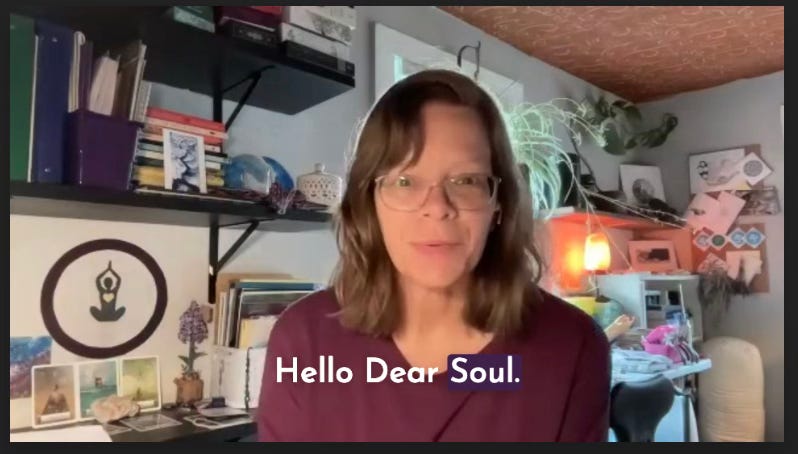
I talk more about it in this musing …
The resonance that we bring to our presence in the world - harried, hurried and stressed or calm, at ease and trusting - impacts everyone and everything around us. If we want cooler heads to prevail, we must invest in being one of those cooler heads. If we want open hearts to prevail, we must invest in being one of those open hearts. We cannot wait for everyone else to get on board - it begins with each and every one of us taking responsibility for our presence in the world and moving from there.
Starting is simple with mini breath breaks.
Sending you Love,
Tawnia
TRANSCRIPT:
“Hello Dear Soul.
I’ve been talking periodically quite a bit about the nervous system lately, and you may be aware that my perception of us as physical presences is that our nervous system is kind of like an electrical system or an antenna, if you will, that’s broadcasting and receiving pretty much all the time, whether we are intentionally interacting with it or not.
Right now as I look out at the world, I see the results of what can only, in my mind, be seen as these electrical system, these antennas that are running at or beyond the capacity that they can actually hold. And what this might look like is people that you know making decisions, or choosing not, honestly, to make decisions- which when we choose not to decide, it is ultimately a decision, eventually, it will result in consequences as though we had made the decision not to act, not to participate, not to whatever. So not deciding is a decision in itself, and when our systems are overwhelmed, the not deciding, the not taking action, the not showing up the, or the opposite, the overcommitting overdoing over speaking, overthinking, that kind of dominating behavior in an effort to sort of control what feels completely chaotic and overwhelming to us- so the two ends of the spectrum would be that complete collapse and numbing and inability to show up to life at all; basically the capacity of the system is so overwhelmed that it results in kind of a breakdown. To use the electrical system analogy, the breaker gets thrown, and so just nothing, nothing is happening.
The other side of the spectrum is the, generally in an effort to try to maintain some degree of sense of control, is to overdo. As an electrical system, I guess you would see this as an electrical system having too much and sparking out. So the overage of electricity then is like distributed, it is broadcast, if you will. So there’s the overwhelm that collapses the system and there’s the overwhelm that then results in this broadcasting of the excess.
Neither of these are sustainable ways to move through the world. Nor are they ways that are healthy. Our system will become depleted in either one of these cases because it’s just not able to function in the way that it’s designed, in its natural way. And both of these can result in ruptures in our relationships, in inadvertently creating additional obstacles in our life that actually increase our sense of overwhelm and so many other things. And so one of the most accessible ways that I know to proactively interact with our systems on a regular basis and help our nervous system recalibrate and and discharge some of that energy when we’re still just operating at capacity or a little below capacity to help us stay in that more natural state.
So often we wait until there’s crisis. I did. My nervous system is the collapse; that’s the habit that my nervous system has developed through the years; that is the pattern that my nervous system has learned, and that is the pattern I am actively interacting with my nervous system over the last, you know, five, seven years to consciously unlearn and relearn how to work with myself to stay within my capacity, and then to expand my capacity so that I can take on bigger things that I can be more resilient, more adaptable in life. So I sit here from a place of experience with this particular thing that I’m speaking of and one of the tools that is incredibly accessible and can be practiced pretty much anywhere is diaphragmatic breathing; slow, deep belly breaths.
And I know it sounds like it’s overly simplistic, but it really truly works. And if you develop a habit of taking mini breath breaks every single day, no matter how you’re feeling- when you feel like you’re all over the place, so you’re on the rollercoaster of nervous system activation and “oh my goodness”, and “what the hell?” and all of that, and on the days when you’re feeling serene and at ease, maybe you have the day off and you’re doing something fun and you’re feeling great. Those things are also contributors to helping our nervous system return to homeostasis. It wants to come back from this chronic state of activation that we tend to find ourselves in right now because we are bombarded with external inputs, even that we’re not conscious of, on a regular basis, every waking moment. We have our phones; we’re connected to other people; we are around other people; we are always taking input in from the people and the presences around us, the environment.
I don’t know if you follow the Schumann resonance at all, but it is the frequency of Mother Earth and there are reports that it’s been doing strange things. It’s been spiking and then dropping and then spiking, and then dropping, and so that resonance of the planet on which we sit invariably impacts our own energetic systems. We are touching Mother Earth at all times and she’s generally pretty consistent in her resonance and that has not been the case for some time now. When these spikes happen, when these drops happen, they definitely impact the energetic system that is us; we are this, this individual sort of organism that is us is an energetic system, and the energy around us does impact us.
Even if we’re not conscious of it- we didn’t know that the earth spiked, we just suddenly had heart palpitations all day or felt a little anxious when we were having a pretty normal day and there was nothing happening specifically to cause that additional anxiety that we could put a finger on, or we just feel we had a good night’s sleep, but we just feel so lethargic and slow and our mind is not operating at the, the pace that we’re accustomed to.
So all of these things in our environment, there are inputs coming in all the time- some that we are aware of, some that we’re not aware of. And so being proactive with investing in creating the space for nervous system regulation or the the room for our nervous system to start to move back in the direction of homeostasis or to come back to homeostasis.
If we are already in that parasympathetic aspect of our central nervous system, slow, deep breaths do no harm. If we are not already in the parasympathetic aspect of our central nervous system, slow, deep breaths help us move into that direction, they help us move back into that homeostatic state where our body can repair, where restoration happens, where digestion is fuller and digestion, yes, of our food, but then also the metabolism that’s happening in our cells and the efficiency with which we are able to rejuvenate and take the cellular waste out of the body and eliminate it and bring fresh new energy in.
All of that is optimized in our parasympathetic state, in our homeostatic state. And so there is no harm done by taking these slow, deep breath breaks all the time. And it’s a habit that we can create, and that is what I encourage you to try. It’s really quite simple. One of the key aspects of a slow deep belly breath is that it is incredibly natural for us to do.
It’s a habit or a pattern that we’ve established somewhere along the lines that we are not breathing that way naturally. So that means that ultimately all we have to do is get outta the way. But that is far easier said than done.
So one of the easiest things for us to do is to bring our attention down into the belly space and notice when we take a slow, deep breath, is our breath mostly centralized at the chest, is it mostly that upper rib cage that’s moving as we inhale and exhale? If it is, then we just need to start to draw the breath a little deeper down into the belly and you can bring your attention there by placing your hands or anything on your belly.
When I used to teach children a lot, I would have a lie on their backs and we would put hands, or a stuffed animal or a yoga block, an eye pillow. There you bring muscular awareness to the lifting of the hands or whatever the object is on your belly, and then the dropping as you exhale.
So you start to kind of retrain the muscular structure to lift with the inhale and to settle back to toward the spine with your exhale. Inviting the breath deep into the lungs this way is an incredibly simple and powerful way that we can consciously interact with our nervous system and help ourselves return back to that parasympathetic aspect of the nervous system, that homeostatic state that helps us have a clear view in the world.
When we are activated, our view narrows, survival becomes the main objective of everything when our nervous system is in its activated state. And so anything that we can do to gently draw ourselves back in the direction of the parasympathetic response, is something that we do to help us make better decisions, to help us build capacity in ourselves and in our lives to receive goodness, to be aware of beauty, to not be overly focused on worry and and things outside of us that are happening that, you know, we may or may not have anything that we can really do about it. And so we are able to be in that kinder, more expansive, more curious state from the parasympathetic aspect of our nervous system, than from the sympathetic- the sympathetic is on survival.
And if you’re kind of tired of being in survival state, one of the foundational practices that you can do every single day to create the capacity in yourself to move in the direction of flourishing and thriving- that happens from a parasympathetic place; from a nervous system that is flexible enough to go into sympathetic when necessary. ‘cause all stress is not bad, it builds resilience and adaptability in our system, but chronically stuck in sympathetic, chronically stuck in activation, chronically stuck in stress response is detrimental to our health.
It’s detrimental to our mind, our physiology, our emotions, and our spiritual selves. So slow, deep breaths, those are the stepping stones on the pathway back from chronic stress response to this more flexible state where we respond appropriately to stress and then our body says, “oh, stress is over. I can come back to homeostasis.”
It’s often called rest and digest, that space within us where we have the capacity to make decisions, view the world, be a presence of softness and safety and kindness. That happens from the parasympathetic state and the easiest stepping stones back to that and it’s not necessarily a rapid trail, but the easiest stepping stones back to that is slow deep belly breaths every single day. And my suggestion to make it easy would be set a timer. Get a breathing buddy.
And set a true intention that is attainable- so not every five minutes I’m gonna take a breath break, or not even five minute breath breaks; “three times a day i’m going to take mini breath break of five, slow deep breaths.” Maybe link it with something so when I wake up in the morning, before I have lunch, and before I go to bed at night, three mini breath breaks; I’m gonna take five slow deep breaths. And if you’re sitting in those five breaths and you have the time and you wanna take 10, great.
But set yourself up for success by saying, this is something I know I can do. Here are the trigger points for when it’s gonna happen, so not just, oh, I’m just, I’m just gonna fit three in, but when in my day am I going to do three? And maybe it’s not three that you start with. Maybe it’s one. Maybe it’s I get up in the morning and I’m going to take five slow, deep breaths before I get up and do anything.
Maybe even before I open my eyes, I’m going to develop a morning habit of starting my day with five slow, deep breaths.
Start where it feels completely attainable for you, and then move from there.
This is an investment worth making, and it is ultimately an investment that pays dividends because you become a presence in the world that is calmer, that is more anchored to peace, that is more able to flex to whatever is changing in your environment appropriately.
So you’re less likely to just fly off the handle, you’re less likely to cause rupture in relationship that you then have to go back to repair. There are in fewer instances where you have to go back and apologize for something that you said, something that you did that was out of character because it was a stress response. It was a sharp bark rather than being able to be the measured response that you might like to have in the world, the kind and considered response that you might choose to have. And that is accessible through that not chronically stressed out response of the parasympathetic aspect of our nervous system.
So I know nervous system is kind of everywhere in the world right now. A lot of people talking about it and it’s great. It’s great, but it doesn’t mean that we’re always blissed out. It doesn’t mean that we’re just kind of flat lining. The healthy nervous system can flex, as needed. It activates in response to stresses, both existential and relatively small in the world. It has the capacity to take in and take on big things, big dreams, big visions, and to not get mired in worry and that sort of unconstructive agitation that we sometimes do when we start to feel overwhelmed and we just don’t know what to do with ourselves.
Slow deep belly breaths. That’s my invitation every day, little mini breath breaks. Start with one- if you’re not in the habit of breathing on a regular, obviously we’re all in the habit of breathing on a regular basis, but if you’re not in the habit of consciously breathing on a regular basis, one a day. Start your day with a slow, deep belly breath, a mini breath break. And then as that becomes a natural habit for you, add another one- add it in association with a trigger though.
So not just “I’m gonna do two.” “I’m gonna wake every morning slow, deep belly breaths. At lunchtime at, I’m gonna set an alarm for a particular time, every time I take the dog out for a walk, i’m gonna take a mini breath break.” Set it up with a trigger so that it can more easily become a habit and your nervous system will thank you.
Your whole self will thank you and so will everyone else around you because it makes a difference- how we show up makes a difference, and these little mini breath breaks can make a difference in how we show up, to ourselves and everyone around us.
I hope you are thriving and I look forward to connecting with you very soon. Sending you lots of Love. Bye.”